

THE STORY
About This Tour
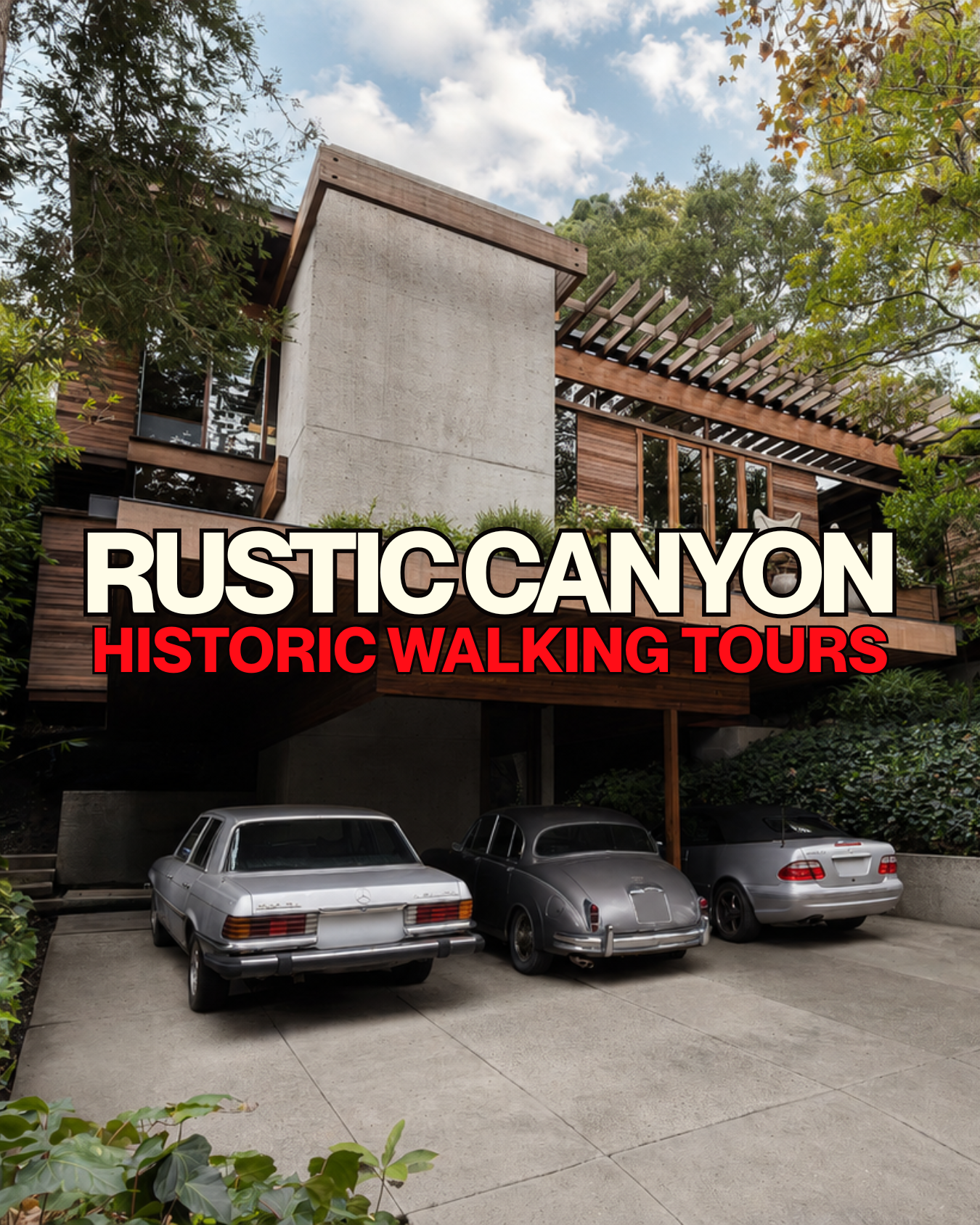
During the 20th century, that setting attracted architects and clients interested in a particularly Californian way of living. The canyon and nearby Santa Monica Canyon became important terrain for modernist experimentation, where houses by figures including Ray Kappe, Craig Ellwood and A. Quincy Jones explored structure, transparency, climate and indoor-outdoor life.
ALONG THE WAY
Featured Stops & Key Locations
Rustic Canyon — the landscape and community history that give the neighborhood its distinctive identity.
Uplifters Club Recreation Center — a 1923 landmark tied to the canyon’s social and recreational history.
Canyon School — a community institution with roots reaching back to the late 19th century.
Eucalyptus Grove — landscape history and the distinctive vegetation of the canyon.
Santa Monica Canyon — the broader canyon system linking the neighborhood to the coast.
Ray Kappe — houses and design ideas that helped define a particularly Southern Californian modernism.
Craig Ellwood — structural clarity, postwar materials and the Case Study generation.
A. Quincy Jones — modern residential design shaped around climate, site and everyday living.
Adelaide Drive & Canyon Architecture — hillside streets where landscape and modernism meet.
Santa Monica Stairs & Coastal Connections — pedestrian infrastructure and the transition from canyon to coastal Los Angeles.
THE EXPERIENCE
What the Walk Feels Like
The experience is especially rewarding for architecture and design enthusiasts, but it also works as a broader history of how the Westside grew. Expect quiet streets, mature trees, hidden architectural details and a much deeper understanding of why Rustic Canyon became such fertile ground for modern California design.
DESIGN IN CONTEXT
History & Architecture Focus
We look at the work and influence of Ray Kappe, Craig Ellwood, A. Quincy Jones and other architects associated with Southern California modernism and the Case Study era. The focus is not simply on names, but on the design ideas they were testing: open plans, structural clarity, economical materials, modular thinking and a fluid relationship between interior and exterior space.
LANDSCAPE + CITY
The Neighborhood Story
That geography also encouraged a more informal pattern of development than the rigid street grids found elsewhere in Los Angeles. Modern architects took advantage of the resulting lots and vegetation, making the canyon an ideal place to explore structures that opened to nature rather than separating from it.
AT A GLANCE
Tour Details
A CLOSER LOOK
A Closer Look at the Tour
A visual preview of the architecture, landscape and streets that shape the experience.


BEFORE YOU COME
What to Know Before Your Tour
Arrive 10–15 minutes early
Comfortable walking shoes, water, sun protection and light layers.
Moderate walking with 3–4 public staircases, canyon terrain and approximately 3.5–4 miles of walking. Comfortable walking shoes, water, sun protection and light layers are recommended. Check your selected session for exact start/end time.
GUESTS + PRESS
What People Are Saying
From longtime Angelenos rediscovering their own neighborhoods to visitors seeing Los Angeles through a completely different lens — plus recognition from some of the city’s most trusted cultural voices.
“I’ve lived in LA for 10 years and learned more in 3 hours than I ever have. Incredible depth without ever feeling overwhelming. It made me appreciate neighborhoods I thought I already knew!”
“Easily one of the best things we did in Los Angeles. It felt curated, intentional, and surprisingly personal for a group experience. Would absolutely recommend.”
“This wasn’t just a tour — it completely changed how I see the city. The stories, the architecture, the context… everything finally clicked. This is hands down the best way to actually understand Los Angeles.”
“You’ll also see often-overlooked landmarks, historic homes, architectural gems and hidden pathways and hear stories about the city’s history and rise of the film industry.”
 PRESS
PRESS“Charlie Ryan and partner Thom Vest have taken their fun, friendly and wildly popular LA Explained Instagram account, celebrating LA’s past, present and future.”
 PRESS
PRESS“Each immersive experience explores the hidden history, architecture, landmarks, and cultural stories that helped shape the story of Los Angeles.”
 PRESS
PRESSHistoric Walking Tour Giftcards!
Give the Gift of Los Angeles.
Treat friends and family to an afternoon spent exploring the history, architecture, and hidden stories of the city. LA Explained Walking Tour Gift Cards can be used toward any public tour. They choose the tour. They choose the date. You get credit for giving a genuinely good gift.
Digital delivery. Flexible redemption. No wrapping paper required.
From $25
Gift a Walking Tour

Every LA Explained tour is built from archival research, architectural history, neighborhood stories, cultural context and the details that usually disappear between the landmarks.
We connect buildings to the people who lived in them, streets to the forces that changed them, and individual neighborhoods to the much larger story of Los Angeles.
The goal is simple: after walking with us, you should never see the city quite the same way again.
Visit InstagramWHY LA EXPLAINED
A New Way to See LA.
GOOD TO KNOW
Frequently Asked Questions
What exactly is the Rustic Canyon Historic Walking Tour?
LA Explained’s Rustic Canyon Historic Walking Tour is a guided architecture and neighborhood-history walk through Rustic Canyon and nearby Santa Monica Canyon, with a major focus on Southern California modernism, canyon development, and the relationship between houses and landscape. The route combines early community history, hidden Westside streets, public stairways, and significant modern residences into one of LA Explained’s most design-focused Los Angeles walking tours.
How long is the Rustic Canyon tour, and how much walking is involved?
Plan for approximately 2.5 hours and about 3.5–4 miles of walking. The route is moderate and includes canyon grades, changing elevation, and several public staircases, so guests should wear comfortable shoes and be prepared for a more active architecture walk than a flat city-center tour.
Is this a Los Angeles modern architecture tour?
Yes. Rustic Canyon is especially strong for guests searching for a modern architecture tour in Los Angeles, because the route explores postwar design, indoor-outdoor living, hillside construction, and the work or influence of architects including Ray Kappe, Craig Ellwood, and A. Quincy Jones. We explain the design ideas in accessible language while still offering enough detail for serious architecture enthusiasts.
Does the tour cover Case Study Houses and Case Study-era architecture?
The tour discusses the Case Study generation and the broader postwar experimentation that transformed residential architecture in Southern California. Rather than promising access to any single private house, we use the architecture in and around Rustic Canyon and Santa Monica Canyon to explain the materials, structural ideas, glass walls, open plans, and indoor-outdoor relationships associated with Los Angeles modernism.
Which architects are discussed on the Rustic Canyon architecture tour?
Architects including Ray Kappe, Craig Ellwood, and A. Quincy Jones are important to the route, alongside other designers who experimented with the Southern California landscape and modern residential living. Their work helps us compare different approaches to structure, privacy, topography, climate, and the relationship between a house and its canyon setting.
What is special about Rustic Canyon and Santa Monica Canyon?
These canyon communities preserve an unusually intimate mixture of early Los Angeles history, landscape, recreation, and experimental architecture. The terrain shaped roads, schools, club life, stairways, and residential design, while the relative seclusion of the canyons attracted architects and clients willing to rethink how people could live on the Westside.
Does the tour include early neighborhood history as well as modern architecture?
Yes. The walk includes context around early institutions and community life, including the Uplifters, the historic Canyon School, eucalyptus landscapes, and the development of Rustic Canyon and Santa Monica Canyon. That older history matters because it explains the social and physical setting into which later modernist architecture was inserted.
Is this tour appropriate for architecture professionals and design enthusiasts?
Absolutely. Architects, designers, preservationists, and modernism fans will find substantial material, but no formal architecture training is required. The tour balances building-specific observations with the larger history of Los Angeles modern architecture, postwar domestic life, canyon planning, and landscape so that both professionals and curious first-time guests can follow the story.
What should I wear and bring, and are food or drinks included?
Wear comfortable walking shoes and bring water, sun protection, and light layers. Food and drinks are not included with standard public tickets; for private Rustic Canyon architecture tours, design-team outings, corporate groups, and custom experiences, LA Explained can incorporate hospitality when appropriate.
Can I book a private Rustic Canyon or Santa Monica Canyon architecture tour?
Yes. LA Explained offers private Rustic Canyon and Santa Monica Canyon tours for architecture firms, design teams, companies, families, visiting guests, and special occasions. Private experiences can be tailored around modernism, Case Study-era design, Ray Kappe, Craig Ellwood, A. Quincy Jones, canyon history, landscape, pace, or broader Los Angeles architecture interests.
MAKE IT YOUR OWN
Private & Custom Tours


THE SUNSET STRIP CLASSIC
The Strip Is Smokin’ Again.
A wearable piece of Los Angeles history. Inspired by the legendary Sunset Strip smoking-cowboy billboard, the Sunset Strip Classic Tee brings one of LA’s most unforgettable roadside icons back to life in a premium vintage-inspired cotton tee.
$29.99
Shop the Sunset Strip Classic